Data Flow Optimisation: Automating and Synchronising Systems with Apache Airflow and dbt
Moving from Shadow Data to a Controlled, Sovereign Infrastructure: Industrialising Sandaya’s Data Pipeline
 Codéin
05/03/2026
Key elements
The challenge : Move away from a legacy approach characterised by Shadow Data (manual CSV flows and fragmented data across the PMS and other tools), which hindered traceability and maintenance.
The objective : Redesign and centralise all data flows between the key components of the information system: CRM, Accounting, PMS and BI.
The solution : Deploy an industrial-grade infrastructure orchestrated by Apache Airflow and dbt, following a “Data as Code” approach (Git versioning, automated testing).
The result : Fully centralise data flows within a single pipeline, eliminating silos and ensuring reliable, actionable data for all business teams.
Context and challenges
Sandaya, a major player in the outdoor hospitality industry, undertook the modernisation of its Property Management System (PMS), the core tool used to manage its operations.
The main challenge was to redefine all flows connecting the PMS to the Accounting, CRM and Business Intelligence systems in order to ensure a migration with no loss of information.
We had to carry out a complete and compliant redesign of the data flows (ISO, meaning a migration with an identical functional scope) while reducing transfer errors.
At the same time, we needed to provide clear monitoring interfaces, ensure data traceability, centralise flow management and create a robust architecture for simplified maintenance.
Choice of partner and solution implemented
The solution combines Apache Airflow and dbt to orchestrate and transform data flows between the PMS, CRM, Accounting and BI systems.
- Apache Airflow provides powerful orchestration and real-time monitoring of each flow, ensuring full visibility across information system exchanges.
- dbt (data build tool) makes it possible to model and document data according to industrial-grade standards, transforming Shadow Data into structured, reliable assets.
The “Data as Code” approach applies DevOps best practices to industrialise and improve the reliability of data flows. Unlike “black box” SaaS solutions, combining Open Source technologies with on-premise hosting gives Sandaya full sovereignty, control over its costs and a fully extensible, tailor-made architecture.
System quality is secured through a rigorous development cycle: Git versioning, systematic code reviews and automated testing. This methodology provides full traceability and enables each update to be deployed to production with confidence.
Testimonial
The Codein team has primarily been responsible for Sandaya’s e-commerce website for many years. Very satisfied with the results, we decided to entrust them with implementing a data / ETL stack at the heart of our web ecosystem. Our e-commerce site reliably handles hundreds of thousands of requests from our users every week. The monthly update cycle provides a high level of responsiveness, all within a friendly and relaxed working relationship. Special mention to our new data team, which is off to a very strong start ;)

Project timeline
The project began with a strategic POC to validate the technical feasibility of the target architecture. This stage confirmed the relevance of combining the Open Source solutions Apache Airflow and dbt before rolling them out at scale.
- Inventory and reverse engineering: In-depth work was carried out through business workshops to identify Shadow Data scattered across the information system. Together with Sandaya, we performed comprehensive reverse engineering of the existing flows to precisely map the fields, calculation rules and mapping required from the new PMS data.
- Medallion architecture: Development was structured around a layered architecture (Bronze, Silver, Gold). This approach makes it possible to consolidate the loading of raw data, which is then transformed using dbt to feed several outbound flows consistently.
- The pre-production challenge: Validation was a major challenge, as some target systems, such as Accounting, were difficult to simulate in a test environment. We had to apply additional rigour to validate behaviour under normal operating conditions despite the absence of certain mirror environments.
- Deployment and stabilisation: The production rollout included a critical stabilisation phase. A technical and functional squad was mobilised to handle edge cases and failures associated with real-world data volumes.
- Resilience and observability: Apache Airflow’s advanced features were instrumental in monitoring flows and ensuring their resilience. dbt’s flexibility made it possible to quickly adjust business rules based on field feedback, enabling rapid stabilisation and compliance with SLAs.
In conclusion, this iterative deployment transformed an architecture that was previously difficult to control into a managed system, with technical control of the stabilisation phase proving key to Sandaya’s operational success.
Results and next steps
The project transformed Sandaya’s data into a manageable industrial asset. From an approach fragmented and siloed by business function, we converged towards a centralised data layer serving as the single foundation for the entire information system.
- Quantitative indicators: Daily synchronisation of 35 sources, more than 3,000 API calls per day and 50 million rows processed annually with maximum reliability.
- Operational gains: Elimination of “Shadow Data” flows and manual tasks (CSV). The system can now be updated dynamically, with some flows refreshed as frequently as every 10 minutes.
- Sovereignty: Control over infrastructure costs and data assets through a self-hosted solution on a sovereign cloud, ensuring strong strategic autonomy and avoiding vendor lock-in.
Next steps: Building on this new centralised foundation, the ambition is to extend the data pipeline to all business functions (Marketing, HR, etc.). This foundation is becoming the company’s single data repository, directly queryable by BI tools to provide a 360° view of the business.
This centralisation provides the foundation for future data governance initiatives. The objective is now to ensure clean, sustainable and shared information, thereby initiating a genuine long-term transformation of Sandaya’s data culture.
Best practices
Reverse-ETL workshops: Do not simply “move” the data; understand its final use (PMS to Accounting) so the format can be adapted from the Silver layer onwards.
“As Code” documentation: Use dbt to generate living documentation shared between technical and business teams, breaking down knowledge silos.
Iterative approach (POC first): Validate technical feasibility and identify critical blockers before deploying the complete architecture, reducing technological risks at an early stage.
Hybrid squad: Maintain close collaboration between data experts and business representatives during the stabilisation phase to respond quickly to edge cases.
Points of caution
Pre-production debt: The difficulty of simulating certain third-party systems (Accounting) requires extreme rigour when moving to production, as the final edge cases only emerge under real-world conditions.
Balancing consolidation and independence: While centralisation guarantees a single source of truth, it also creates dependencies between flows. The challenge is to consolidate shared resources while isolating business logic to ensure overall resilience.
Source data quality: Industrialisation does not correct data-entry errors at source. Strict input monitoring is essential to prevent incorrect data from being propagated at high speed throughout the information system.
Comments
No comments yet. Be the first to comment!
You must be signed in to add a comment.
Dated at the model level
- Review by
- 21/03/2027


Camping Sandaya
Tags
REX produced by
Project images
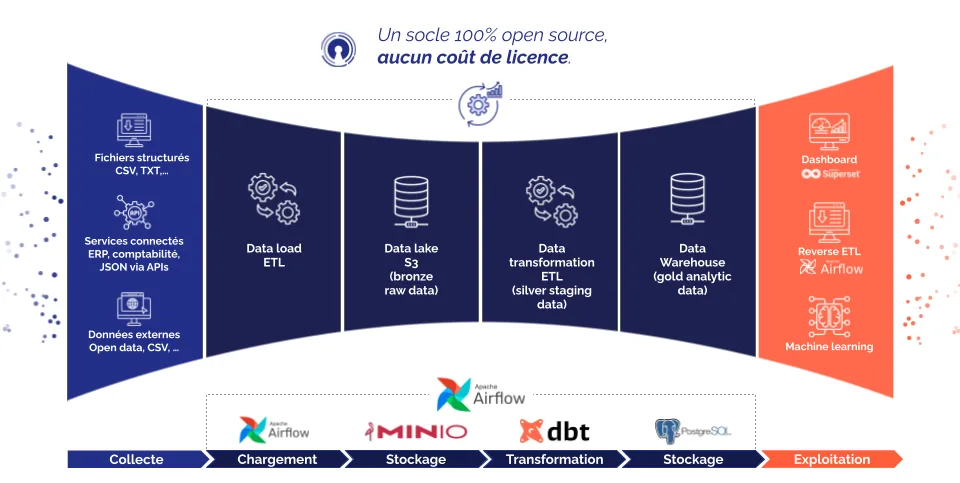
Pipeline de données
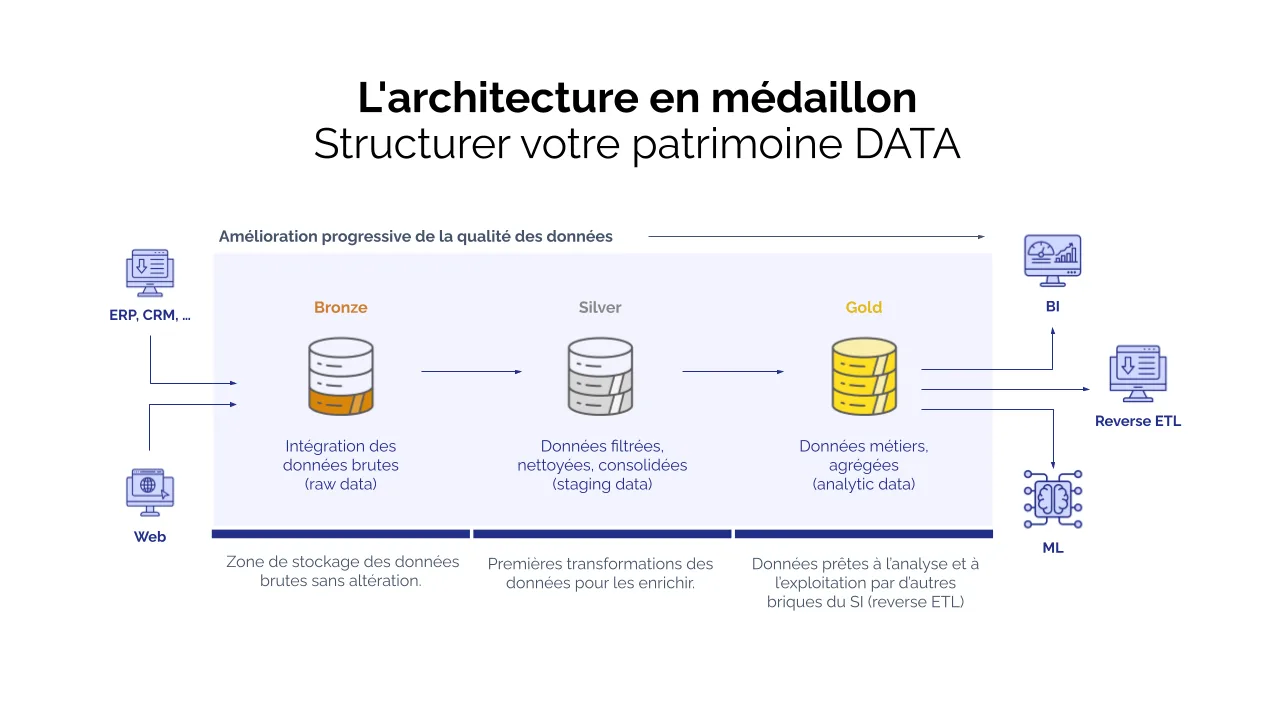
Data : architecture en médaillon