OPPBTP - Redesign of a Critical Business Software Suite for Risk Prevention in the Construction Industry
Progressive modernization of a complex application ecosystem serving a leading national organization
 Codéin
26/03/2026
Key elements
Challenge : OPPBTP relied on a platform built between 2012 and 2020 using eZ Publish. Over time, the accumulation of tools had formed a rigid monolith, creating blocking technical debt, recurring performance issues, and software obsolescence that was difficult to address. Behind this technical constraint lay a major challenge : keeping a critical business software suite operational at national scale for risk prevention in the construction industry.
Solution : The application was broken down into independent services, each exposing its functionality through REST APIs. The selected technology stack — Symfony, API Platform, and React — was chosen for its maturity : proven technologies supported by large communities and suited to the business complexity and long-term maintainability requirements of a project of this scale.
Result : The transformation, carried out between 2020 and 2026, covered 12 business tools and avoided a big-bang migration. A structured migration plan made it possible to prioritize workstreams and migrate applications one after another without service disruption. The software suite now serves 100,000 registered users, including approximately 60,000 active users. Each application is autonomous : it can evolve, be maintained, or be managed independently of the others. This gives OPPBTP genuine flexibility in its technical and strategic decisions.
Context and challenges
The French Professional Organization for Prevention in Building and Public Works (OPPBTP) is responsible for raising awareness among industry stakeholders in order to prevent workplace accidents and occupational illnesses and improve working conditions. To fulfill this mission, the organization provides a web platform delivering personalized content and a range of connected SaaS services dedicated to construction companies.
Between 2012 and 2020, the successive addition of around ten tools within a monolithic eZ Publish architecture generated critical technical debt and significant performance issues. Outdated software versions and the system's growing complexity gradually blocked its ability to evolve, just as web usage patterns were undergoing profound changes.
In this context, Codéin was commissioned to define and lead a global migration strategy : transform this massive system into a suite of independent services, restore the autonomy of each business tool, and modernize the user experience. The chosen approach — progressive, batch-based, and without a tunnel effect — was designed to ensure service continuity and the long-term sustainability of the solution.
Choice of partner and solution implemented
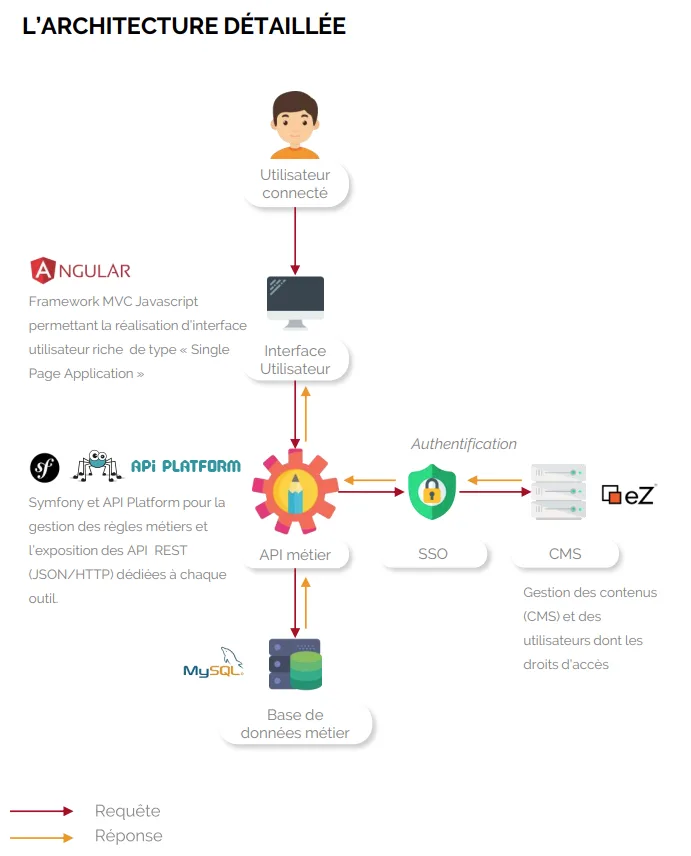
Given the platform's functional complexity and the heterogeneous nature of its components, the selected architecture is based on a division into independent services : each business tool becomes an autonomous, specialized unit that communicates with the others through REST APIs. The approach was not a like-for-like technical migration, but a complete redesign of each tool in order to rebuild on solid foundations and meet current usability and business requirements.
The separation of software layers lies at the heart of this architecture. On the front end, each application is developed in React as a Single Page Application. On the back end, business logic and data access are handled by Symfony and API Platform. This clear separation between the interface and the business engine provides immediate reusability : the exposed APIs can power mobile applications, partner portals, or any other channel without rewriting the application core.
A critical challenge in the progressive migration was authentication management. To minimize disruptions to the user experience while the legacy platform and new services coexisted, an SSO (Single Sign-On) solution was deployed in advance. Bridges were implemented to ensure session continuity between environments, although the transition period required some adjustments for users. This mechanism was a key prerequisite for making the progressive migration viable in production.
Testimonial
A dedicated and available team, attentive to the needs of the client and its users. Proactive in its recommendations and determined in finding solutions.
Project timeline
The migration strategy was validated through an initial concrete case : the redesign of the risk assessment tool (EVR). This service lies at the heart of OPPBTP's offering, enabling companies to meet their regulatory obligations by preparing their Single Occupational Risk Assessment Document (DUERP).
Its selection as the first application to be migrated was deliberate : an urgent need for modernization, a low level of dependency on other services, and a high stability requirement due to its central role in the platform's day-to-day use.
The most demanding workstream was the migration of business data : millions of records from the historical single database had to be redistributed into a redesigned and optimized EVR database. Codéin structured this process into four phases : data definition and qualification, raw extraction, validation and loading, followed by migration verification to ensure service continuity and data integrity throughout the transition.
The success of this first migration validated the target architecture and enabled the process to be industrialized for subsequent workstreams. A shared design system was implemented in parallel to ensure a consistent user experience across all migrated tools, regardless of their redesign schedule.
Results and next steps
OPPBTP's progressive migration has delivered measurable results in terms of both adoption and the platform's technical robustness. The software suite now supports 60,000 user companies, with a sustained rate of 1,000 new registrations per month.
For the EVR tool alone, the figures demonstrate the platform's intensive use :
- Risk assessments recorded : 70,000
- Prevention actions created : 500,000+
- Entries in the business / risk reference database : 2 million+
- Database records : 100 million+
The solution is accessible on all devices : desktop, tablet, and mobile.
Comments
No comments yet. Be the first to comment!
You must be signed in to add a comment.
Dated at the model level
- Review by
- 28/03/2027

Refonte d'une suite logicielle métier critique pour la prévention des risques dans le BTP
Tags
REX produced by
Project images
Architecture détaillée