Toulouse-Blagnac Airport : Managed Services for the Sylius E-commerce Website
Toulouse-Blagnac Airport entrusts Codéin with the cloud infrastructure for its Sylius-based e-commerce website
 Codéin
04/06/2026
Key elements
- Challenge : Toulouse-Blagnac Airport needed to rely on AWS Cloud to implement a secure and scalable architecture while ensuring maximum service availability.
- Solution provided : Complete migration of the website to a public cloud infrastructure (client's choice) based on containers (AWS ECS selected). AWS deployment across 2 Availability Zones (Multi-AZ). Use of a CloudFront CDN combined with AWS WAF.
- Results : A deployment consistent with the client's other infrastructure, offering simplicity, rapid implementation, and easier adoption. Deployment across 2 zones ensures service continuity in the event of a server or data center failure. The website is secure, optimized for loading times, and benefits from anti-DDoS protection. A scalable platform designed to meet the client's growth requirements.
Context and challenges
Toulouse-Blagnac Airport is currently the 4th-largest airport in France, with more than 7 million passengers per year. The airport is also pursuing a strategy to diversify its non-aeronautical revenue streams.
This strategy is based on the sale of services directly integrated into the passenger journey, such as parking reservations, access to private lounges, and fast-track services. The management of these consumer-facing assets relies on yield management to optimize parking occupancy rates and average spend per passenger according to traffic forecasts, seasonality, and flight flows.
As part of the redesign of its Sylius-based website, Toulouse-Blagnac Airport wanted to consolidate its infrastructure by relying on the AWS public cloud. The requirement was to implement a secure, scalable architecture with a high level of availability on AWS public cloud.
Choice of partner and solution implemented
AWS Cloud was a client requirement to maintain consistency with the rest of its infrastructure.
We chose AWS ECS over EKS because it matched the simplicity of the requirement, enabled faster implementation, and made the solution easier for developers to adopt.
Project timeline
The infrastructure entry point is secured and optimized through the combination of CloudFront and WAF (Web Application Firewall), which acts as the first point of contact. Traffic is then routed to an ELB (Elastic Load Balancer), which distributes requests across the container cluster.
The core of the application is orchestrated by AWS ECS within a private network. It continuously runs 3 tasks (containers), each with 4 vCPUs and 8 GB of RAM :
- Front-end service : 2 containers distributed with high availability across two separate Availability Zones (Paris-1 Availability Zone and Paris-2 Availability Zone).
- Batch / Worker service : 1 container dedicated to running background tasks (located in the Paris-1 zone).
Internet access for the containers is provided by the NAT Gateway service, with redundancy across each Availability Zone.
Databases : Storage and cache services (MariaDB and Redis) benefit from full replication and redundancy across both data centers (Paris-1 and Paris-2 zones) to ensure high availability.
Results and next steps
- The infrastructure was deployed on the AWS public cloud as required by the client, using a container-based architecture powered by AWS ECS.
- The infrastructure is robust thanks to 2 Availability Zones, ensuring service continuity for the website in the event of a failure.
- The website is secured through a CloudFront CDN combined with AWS WAF.
- The platform is scalable to meet growth requirements.
We also stayed within the initial cost estimate by implementing a FinOps approach, which helped optimize the cost of using AWS services.
We also applied a DevOps methodology with continuous deployment, enabling developers to gain autonomy, responsiveness, and reliability in software delivery.
Comments
No comments yet. Be the first to comment!
You must be signed in to add a comment.
Dated at the model level
- Review by
- 04/12/2026

Tags
REX produced by
Project images
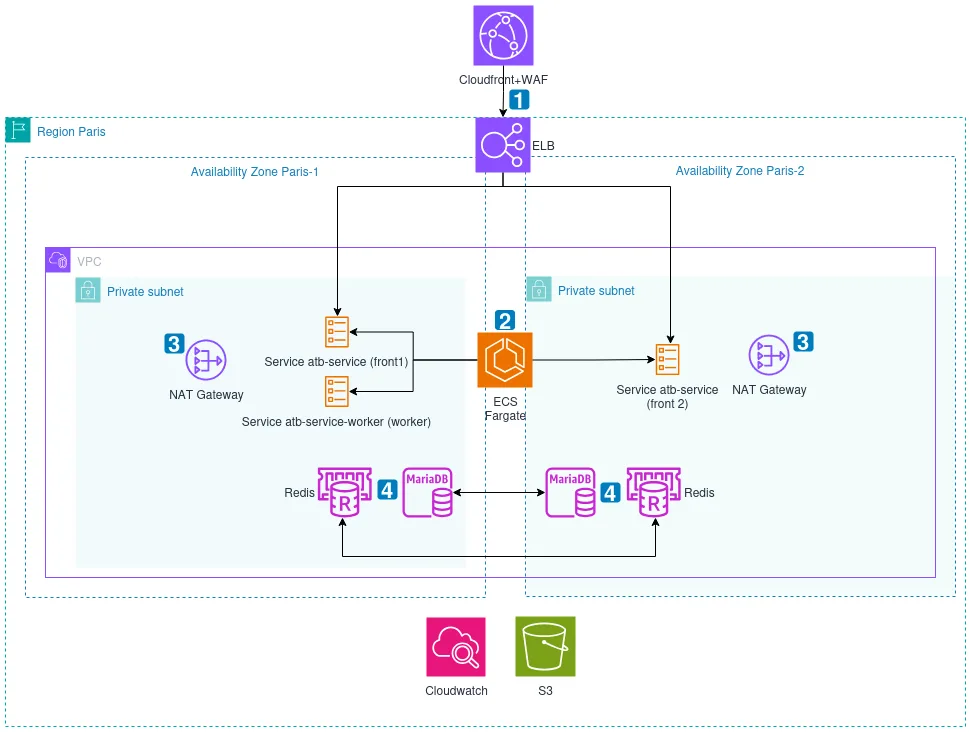
Schéma de l'infrastructure cloud ATB